Accessibility and inclusion in occupational therapy education: Universal design for learning
Universal Design for Learning (UDL) is a foundational educational framework designed to ensure that learning is both accessible and meaningful for every learner (CAST, 2024; Meyer & Rose, 2024). In a study by Murphy et al. (2020), findings suggested that “knowledge of the UDL principles and a greater breadth and depth of instructional strategies may facilitate greater learning outcomes in occupational therapy students” (p. 302). By embracing varied learning needs, UDL creates an accessible collaborative and inclusive educational environment, fostering a sense of community and belonging among learners and educators. See Figure 1 for an overview of the UDL principles and examples for implementation.
Figure 1. Three Core Principles of Universal Design and Examples
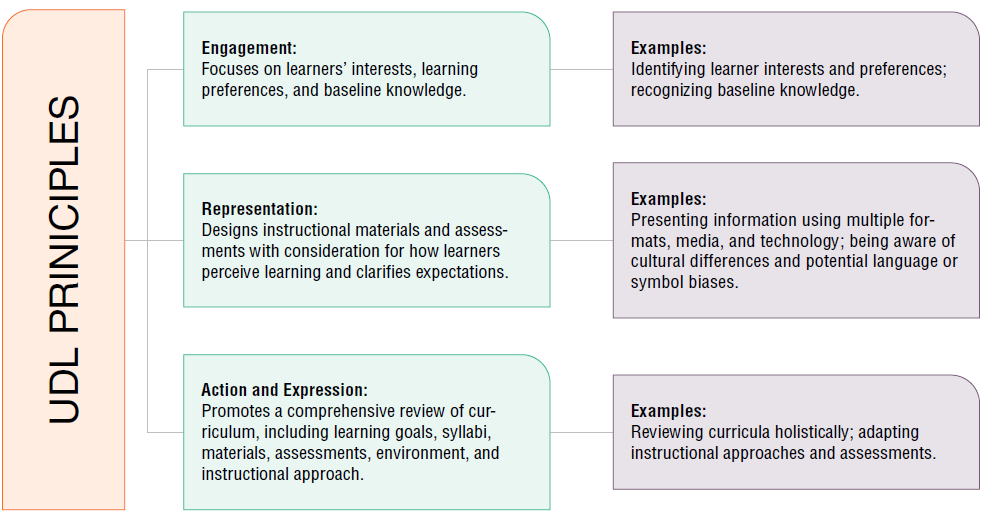
Adapted from: CAST (2024). Universal Design for Learning Guidelines version 3.0. https://udlguidelines.cast.org; Gordon, 2024. Universal design for learning: Principles, framework, and practice. CAST Professional Publishing.
UDL emphasizes learning environments that are accessible and adaptable while acknowledging learners who were previously considered to be on the margins of learning as an integral part of the educational structure. As such, UDL can assist occupational therapy educators in planning and designing content that accommodates the varying learning styles of occupational therapy and occupational therapy assistant students within the educational environment.
Fostering Accessible and Inclusive Learning Spaces in OT Education
To prepare OT and OTA learners for success in today’s health care environment, we must prioritize their needs and learning styles. Faculty will need to promote “learner agency that is purposeful and reflective, resourceful and authentic, strategic and action-oriented” (Meyer & Rose, 2024, p. 162). Therefore, OT and OTA educators are poised to naturally implement UDL due to the holistic approach that looks at education from a learner-centered perspective. Table 1 provides example strategies that OT and OTA educators can use to ensure that the learning environment and teaching materials are accessible to and inclusive of all learners.

Incorporating these strategies ensures that the needs of learners are always at the forefront and that they are valued in their educational journey.
Table 1. Strategies and Examples for UDL Implementation
|
Strategy |
Description |
Example |
|
Scaffold Learning |
Allow learners to connect new concepts to their prior knowledge, building a solid foundation for deeper understanding. |
Culturally responsive tiered case studies allow learners to self-select assignment formats, use synchronous sessions to bridge learning for application. |
|
Encourage Diverse Perspectives |
Tailor content to relate to learners’ unique backgrounds and experiences, ensuring it resonates personally. |
Culturally responsive tiered case studies, simulation, and virtual simulations. |
|
Leverage Technology Thoughtfully |
Integrate tools and resources that align with specific learning objectives to enhance outcomes. |
Use educational tools such as Poll Everywhere, Kahoot, Padlet, and virtual simulations and video case studies. |
|
Prioritize Accessibility |
Make all materials universally accessible. |
Utilize aids such as closed captioning, transcripts, alt text, infographics, and graphic organizers. |
|
Facilitate Communication |
Create opportunities for interaction. |
Virtual office hours, group discussion, or forums. |
|
Prepare Learners |
Share instructional content in advance to encourage active participation. |
Provide handouts, presentation notes, and lesson plans before class meetings. |
|
Design Real-World Tasks |
Ensure assignments mirror practical, real-life scenarios to create meaningful learning experiences. |
Service learning, pro-bono Clinic, high fidelity simulations. |
|
Promote Reflection |
Incorporate reflective exercises to help learners assess their programs and refine their learning approaches. |
Journaling, reflective group discussions, digital storytelling. |
Adapted from: CAST (2024). Universal Design for Learning Guidelines version 3.0. https://udlguidelines.cast.org; Gordon, 2024. Universal design for learning: Principles, framework, and practice. CAST Professional Publishing.
Incorporating UDL principles into occupational therapy education aligns with the American Occupational Therapy Association (AOTA)’s Vision 2030, which emphasizes creating accessible supportive environments that foster “belonging, collaboration, and continuous learning” (AOTA, 2025, para.6). This approach ensures that instructional experiences remain accessible, adaptable, and responsive so that every learner can thrive.
References
American Occupational Therapy Association. (2025). Vision 2030. American Journal of Occupational Therapy, 79, 7904420010. https://doi.org/10.5014/ajot.2025.794010
CAST. (2024). Universal Design for Learning Guidelines version 3.0. https://udlguidelines.cast.org
Meyer, A., & Rose, D. H. (2024). Universal design for learning: Principles, framework, and practice (2nd ed.). CAST Professional Publishing.
Murphy, L., Panczykowski, H., Fleury, L. & Sudano, B. (2020). Implementation of universal design for learning in occupational therapy education. Occupational Therapy In Health Care, 34, 291–306. https://doi.org/10.1080/07380577.2020.1780663
Gayla Aguilar, PhD, OTD, OTR/L, has been practicing for 30 years, specializing in pediatrics and autism. She holds a PhD in Health Psychology and is the Program Director for the OTD program at Hanover College in Hanover, IN.
Rocio Alvarenga, EdD, MOT, OTR, has been practicing for 15 years, specializing in wellness and education. She is currently the Occupational Therapy Content Development Manager at the University of St. Augustine for Health Sciences in St. Augustine, FL.
Inti Marazita, PhD, MS, OTR/L, has been practicing for more than 28 years and specializes in pediatrics, mental health, and education. She is the Director of Occupational Therapy Academic Projects at the University of St. Augustine for Health Sciences in St. Augustine, FL.
Thais Petrocelli, OTD, MHA, OTR/L, has more than 21 years of experience in practicing occupational therapy, specializing in mental health, community-based programs, pediatrics, and hybrid learning. She is the Director of Fieldwork for the OTD program at Hanover College in Hanover, IN.
Sharon Wright, OTD, OTR/L, has more than 30 years of experience in occupational therapy practice, specializing in adult neurorehabilitation. She is the Director of Admissions for the OTD program at Hanover College in Hanover, IN.