Mentoring in a busy world

As occupational therapists enter the workforce and complete their academic training, they are challenged to begin practicing independently; drawing from all the skills acquired in the classroom and while on fieldwork assignments. Some new clinicians start off in work environments with other occupational therapists and have significant supervision that typically includes mentorship. However, others may be entering a work setting where they are the only occupational therapy practitioner. As clinicians grow in their careers and establish professional goals, a new phase of mentoring needs arises as they work to hone their skills, find their path, and seek out opportunities to bring their career to the next level. Different types of mentoring relationships exist, some of which are designed to be shorter term, guiding a clinician in achieving a new clinical skill set. Other times, a clinician may be seeking a longer-term mentoring relationship, designed to help them set and achieve professional goals.
Foss defined mentoring as “a developmental partnership that has as its primary focus professional, career development, or personal growth” (Foss, 2010, p. 238). Mentoring is often thought of as primarily having benefits for the mentee, but in reality, mentors often gain just as much from the relationship. In an article by Burgess and colleagues (2018), they list increased self-efficacy and increased job satisfaction as some of the benefits for the mentee, but also point to benefits for the mentor: personal fulfillment, development of coaching skills, and renewed interest in their career.
Occupational therapy practitioners interested in a longer-term mentoring relationship may need to look outside their immediate workplace. This can be a challenge, especially for those who work in unique areas of practice or in a more rural area.
Clinicians can connect with others who have similar interests through the AOTA Communities of Practice or AOTA’s CommunOT collaboration site. Additionally, AOTA is in the process of developing a new leadership program.
AOTA’s expanded Vision 2025 (AOTA, 2019) identifies leadership as one of the five pillars of the occupational therapy profession—it states that “Occupational therapy is influential in changing policies, environments, and complex systems.” Vision 2025 (AOTA, 2017) served as a call to action, and in response, in 2017 the Illinois Occupational Therapy Association began creating the Leadership Development Program (LDP). The program took nearly 2 years to complete, because the LDP Steering Committee had numerous decisions to make. First, the committee members had to consider their target audience—ultimately deciding to include practitioners in all stages of their careers. Then, they had to develop the program application process, ensuring that it was rigorous enough to identify dedicated applicants but not so rigorous that busy professionals would not apply. The committee had to identify the best way to pair mentors and mentees and create documents to facilitate collaborative goal setting. The committee had to identify educational topics to present to each cohort and prepare for the formal training sessions. Lastly, they had to give thought to ongoing recruitment and the sustainability of the program. With these details in place, the LDP launched in 2019 with a primary goal of providing leadership training and ongoing mentorship to practicing clinicians. A secondary aim was to develop a pool of clinicians who would ultimately step into ILOTA as state leaders themselves.
Program participants, both mentors and mentees, are selected via a competitive application process in which they are asked to submit a personal statement of intent, a résumé, and a professional letter of reference. The application is designed to help participants reflect on their personal leadership goals and to form the mentor–mentee pairs. Each pair is then asked to develop a charter that outlines collaborative goals and desired outcomes for the year. Throughout the year, each pair meets individually to work toward their shared goals. The frequency and timing of these meetings is left to each individual pair, allowing the flexibility needed for busy professionals. The larger cohort also meets for more formal trainings, conducted by members of the LDP Steering Committee, to promote leadership skill development and growth. Additionally, a member of the LDP Steering Committee was assigned to each pair to act as a liaison to guide them through the program.
Since its launch, two cohorts have successfully completed the LDP—six pairs the first year and seven pairs the second year. Each cohort was diverse in terms of practice areas and years of experience. In fact, in the second cohort, one participant had more than 20 years of experience as a practitioner but joined as a mentee because she had recently switched practice areas. Participants in both cohorts have commented that the program is enriched by the diversity of pairings.
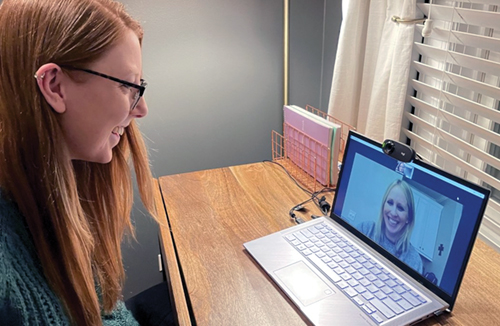
Program Discussion
Jennifer Richert, OTR/L, Associate Director of Internal Staff Development at Shirley Ryan AbilityLab and Lauren Walker, OTR/L, a therapist at Northwestern Medicine’s Department of Psychiatry and Behavioral Sciences Outpatient Clinic, each shared their experience as participants in the second cohort of the LDP.
Mentor/Mentee Pair Dynamics
Walker: I work in an outpatient, psychiatric clinic and have 8 years of clinical experience. My area of expertise is working with young adult clients who have serious mental illness, with a particular focus on first episode psychosis.
Richert: I have 19 years of experience and work for a rehabilitation hospital with inpatient, outpatient, and day rehab levels of care. I oversee our Staff Development department, which provides education, training, and mentoring to allied health staff throughout our system of care. Our department promotes evidence-based practice and professional growth and development within our staff. My clinical background is primarily in pediatrics.
Applying to the LDP
Walker: I initially joined the program because I thought it would teach me how to be a leader. I thought that my mentor would coach me on leadership techniques and that I would emerge from the program ready to take on more responsibility in my practice. When I applied, I initially wrote about my intent to work on policy change regarding reimbursement for psychiatric services.
Richert: I applied to the program with a desire to give back to my profession. As a leader within a hospital system, I recognize the need to encourage other occupational therapy practitioners to step into leadership roles and know it can be daunting in the beginning. I was eager to share my experiences with other clinicians looking to develop their leadership skills. I also was interested in becoming more involved in my profession at the state level.
Collaborative Charter Development
Walker: At the start of the program, mentees are asked to complete a SOAR analysis on themselves; SOAR is a strategic planning technique to help identify strengths, opportunities, aspirations, and results. This process helped me to identify my actual goals, which were much different than my application goals. I realized that I was more interested in teaching, growing the psychiatric practice community, and providing recovery-oriented care to my clients. These goals aligned well with Jennifer’s goals, and we combined them to create deliverables.
Richert: I think the process of creating the charter together was helpful to really dig into and share what each of our respective goals were, and how we could work together on these. We were also paired with a member of the LDP steering committee to guide us in this process (Lisa Mahaffey, PhD, OTR/L, FAOTA) who was helpful in pushing us to think bigger about our goals—of both the program and our professional development goals in general.
Program Goals
Walker: Based on my desire to teach and grow the psychiatric practice community, one goal was to teach a continuing education course to the occupational therapists at Shirley Ryan AbilityLab. The course was on using Taylor’s Intentional Relationship Model in an inpatient rehabilitation setting, focusing on the intersection of both of our practice areas. A second goal, and the impetus for this article, was to share our experience in the LDP.
Richert: I shared the goals Lauren states above, but also wanted to increase my involvement with the state organization (ILOTA) as well as develop my coaching skills, using active listening strategies and probing questions.
Fostering the Mentor/Mentee Relationship
Walker: Jennifer and I met monthly at a minimum. Each meeting was an opportunity to reflect on my own leadership style, especially in comparison to those traditionally in leadership within my own clinic. Discussing different styles of leadership helped to improve my own confidence in my ability to lead a team in the way that felt right to me. The formal relationship with Jennifer also served as a source of accountability to continue working toward the goals that we set over the year and to not let life get in the way.
Richert: I found it helpful to carve out a consistent time for meetings, so that we didn’t let other job responsibilities get in the way of our mentor/mentee relationship and the goals we’d set for ourselves. Although I was the mentor in this relationship, I also found our meetings helpful in my own professional growth, to bounce ideas off Lauren, and share challenges I was having, for her input and insight.
Program Challenges
Walker: Initially, we set a third goal for our charter, which included presenting at our state conference. Over the course of our work together, we realized that our last goal was a deliverable for the sake of having a deliverable, not because the presentation would speak to our area of passion or advance the field. At that time, we recognized that it was important to take a step back from our charter and consider whether our goals were still meaningful and sensible.
Richert: I think the biggest challenge for me was that all deadlines we had within this program were self-imposed. While we certainly felt accountability to each other, it was different than deadlines you may have in your formal work environment, and thus, sometimes easier to procrastinate on. I think this is the same reason work–life balance is so challenging for most people, as tasks that are not essential work tasks are deferred, so it was a good reminder to me to find ways to prioritize those activities that are personally important to you.
Lessons Learned
Walker: Though it seems obvious, I learned that change and personal growth take time. I tend to discount accomplishments because the outcomes seem minimal. Even during the LDP, a nagging voice in my head would say that I wasn’t doing enough. I had to remind myself that over the year, many skills were honed: I improved my communication skills, self-confidence, and self-reliance, and created a broader network of occupational therapists. The course also taught me that leadership happens in small ways, every day. It’s important to reflect on those opportunities and consider how cumulatively they add up to change.
Richert: I learned that mentoring relationships almost always work in both directions. The mentor and mentee learn equally from each other, and foster growth in each other, just by the nature of self-reflection that these types of relationships bring. The benefits are lifelong and are not something otherwise learned by formal reading or study. The human-to-human interaction is key to growth and development.
Conclusion
Ultimately, the LDP is an asset to occupational therapy practitioners across the state of Illinois. To protect participants’ privacy, our LDP participants shared only what they felt comfortable with and there was absolutely no patient information shared at any time. This basic model could and should be replicated across the nation in other state organizations, though it will take a dedicated group of individuals willing to thoughtfully design the structure and recruit applicants. Particular attention should be paid to creating diverse mentor–mentee pairings. These pairs, an essential element of the design, serve to push practitioners in new ways, hold all participants accountable for ongoing engagement, and improve participant retention—leading to an even richer experience throughout the year.
References
American Occupational Therapy Association. (2017). Vision 2025. American Journal of Occupational Therapy, 71, 7103420010p1. https://doi.org/10.5014/ajot.2017.713002
American Occupational Therapy Association. (2019). AOTA Board expands Vision 2025. American Journal of Occupational Therapy, 73, 7303420010p1. https://doi.org/10.5014/ajot.2019.733002
Burgess, A., van Diggele, C., & Mellis, C. (2018). Mentorship in the health professions: A review. The Clinical Teacher, 15(3), 197–202. https://doi.org/10.1111/tct.12756
Foss, J. J. (2010). Mentoring and professional development. In K. Jacobs & G. L. McCormack (Eds.), The occupational therapy manager (5th ed., pp. 237–252). AOTA Press.
Jennifer Richert, OTR/L, is the Associate Director of Internal Staff Development at Shirley Ryan AbilityLab and has practiced as an OT for 19 years. Her current role focuses on the development, training, and mentoring of allied health staff as well as implementation of evidence-based practice throughout all levels of care within her hospital system.
Lauren Walker, OTR/L, has worked at Northwestern Medicine’s Department of Psychiatry for 8 years as an OT. She is currently the co-director of the Recovery from Early Psychosis Program for young adults experiencing their first episode of psychosis. She also directs the Focused Forward program, a multi-disciplinary program to support young adults in returning to work and school.