Sharing our Experience: Results of a Habits-Based Health Promotion Intervention Targeting Unique Stressors of Graduate Students to Support Occupational Well-being
When we entered our occupational therapy studies at Methodist University, like many new graduate students in health science programs, we quickly found ourselves facing increased stress, inconsistent sleep, reduced physical activity, and little free time. To address this common experience, we collaborated with our mentor, Amy Haynes, OTD, OTR/L, to develop and implement a habits-based wellness intervention targeting stress and occupational imbalance among first-year occupational therapy (OT) students. Our goals were to anchor wellness habits to daily routines, enhance social connections, and foster a greater sense of community to improve resilience and academic satisfaction. We’d like to share what we’ve learned and the practical habits that have helped us!
Understanding the Stress Landscape
Graduate-level occupational therapy programs are rigorous, and students often face stressors that can disrupt their occupational balance. Our literature review identified major stress contributors such as academic overload, time pressures, financial concerns, and limited time for social relationships, self-care, or physical activity, which can lead to symptoms such as fatigue, withdrawal, reduced social pleasure, and depressive mood (Stachl & Baranger, 2020).
Why We Chose a Habits-Based Approach
Our literature review showed that consistent, small habits can promote sustained change. We explored work on habit formation and behavioral triggers to create a sustainable model tailored to graduate student needs (Duhigg, 2012). By anchoring wellness habits to daily routines, students were more likely to stick with them, especially when paired with peer accountability (Costello et al., 2022; Freire et al., 2020). We also wanted to enhance students’ social connection, sense of community, and belonging within the program with the hopes of improving resilience and academic satisfaction (Herbert, 2022).
Participants of our 8-week program received weekly themed health and wellness tips and strategies to incorporate into their routines. They were also randomly paired with a partner for 20-minute walk-and-talks. Lastly, participants received a daily survey via text message with seven multiple-choice questions to record their data. Pre- and post-study data were collected on (a) significant factors outside of their academic experience, (b) perceived stress, (c) social assurances, (d) social connectedness, (e) self-efficacy, (f) coping skills, (g) sleep duration and quality.
Five Habits That Made a Difference
Through our program implementation and post-study data analysis, we identified five helpful strategies to promote occupational well-being that can be easily integrated into your own academic journey.
1. Schedule “walk and talks” with a friend.
Combine movement with peer support to make exercise feel achievable and fun. Participants noted that it reduced isolation and encouraged regular social connection. Try scheduling 20-minute walks 2–3 times per week to stay physically active and boost mood and motivation.
2. Prioritize sleep hygiene.
Sleep is often the first thing sacrificed in the daily routines of first-year OT students. Our program emphasized the importance of maintaining consistent sleep and wake cycles, even during busy periods. While it may be tempting to stay up late working on assignments, sticking to a regular bedtime during the week can help with energy, focus, and emotional regulation.
3. Fuel Smart.
Skipping meals or choosing quick fixes is common in grad school. Try setting an afternoon alarm as a reminder to check whether you’ve eaten a proper meal. To stay focused and boost your stamina throughout the day, keep a water bottle and a few nutritious snacks on hand.
4. Use Study Breaks.
Timed study sessions followed by short breaks improved retention and reduced mental fatigue in participants. Taking study breaks after short, intense periods of review or memorization allows the information to settle and gives your brain time to process the information.
5. Integrate Micro-Mindfulness Practices.
Mindfulness can sometimes feel intimidating or time-consuming, but with thoughtful integration, it can significantly build resilience and reduce anxiety. Try pausing to take three deep, intentional breaths during moments of stress to calm your mind and recenter yourself. Other ways to stimulate your parasympathetic nervous system (responsible for rest and digestion) are rocking, humming, and journaling.
Why Balance is Important to Occupational Therapy Practice
As future occupational therapists, we recognize that well-being begins with ourselves. This project taught us how to advocate for daily balance, not only for our clients, but also for our peers and ourselves. Our hope is that by sharing our research with other OT students, you might find ways to build healthy habits, seek out peer support, and develop stress management skills to promote mental and physical health across your academic journey. Learning to maintain occupational balance will allow all of us to become stronger advocates for holistic well-being in our personal and professional lives.
The research skills we gained, including needs assessments, program development, stakeholder collaboration, and sustainability planning, are now guiding our doctoral capstone experiences. We’re proud to carry forward this model into our future clinical and community-based roles. This experience has reaffirmed our belief that occupational therapy is more than a profession—it’s a platform for advocacy, innovation, and lasting change in the lives of those we serve. To students beginning their capstone journey, lean into every challenge as a powerful opportunity to learn and grow, and never hesitate to seek guidance along the way.
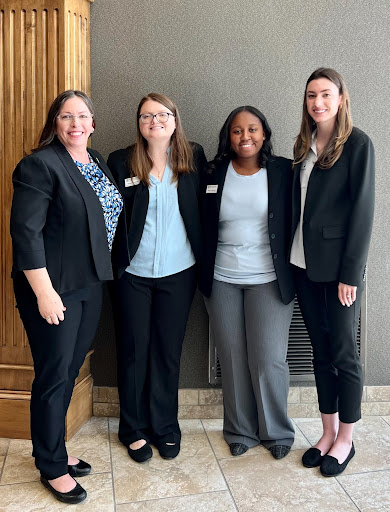
Kelsey Kennedy, Tlejah Chapman, and Leah Shaffer are third-year entry-level OTD students at Methodist University in Fayetteville, NC. They are currently completing their doctoral capstone experience and are looking forward to making a meaningful impact in the field of OT.
We would like to thank Amy Haynes, OTD, OTR/L, for her invaluable guidance and unwavering support, which have profoundly shaped our capstone journey. Her influence will continue to inspire us as we prepare to begin our careers as occupational therapists.
References
Costello, M. A., Nagel, A.G., Hunt, G. L., Rivens, A. J., Hazelwood, O. A., Pettit, C., & Allen, J. P. (2022). Facilitating connection to enhance college student well-being: Evaluation of an experiential group program. American Journal of Community Psychology, 70, 314–326. https://doi.org/10.1002/ajep.12601
Duhigg, D. (2012). The power of habit: Why we do what we do in life and business. Random House.
Freire, C., Ferradás, M. D., Regueiro, B., Rodríguez, S., Valle, A., & Núñez, J. C. (2020). Coping strategies and self-efficacy in university students: A person-centered approach. Frontiers in Psychology, 11, 530329. https://doi.org/10.3389/fpsyg.2020.00841
Herbert, C. (2022, March 4). Enhancing mental health, well-being and active lifestyles of university students by means of physical activity and exercise research programs. Frontiers. https://www.frontiersin.org/articles/10.3389/fpubh.2022.849093/full
Stachl, C. N., & Baranger, A. M. (2020) Sense of belonging within the graduate community of a research-focused STEM department: Quantitative assessment using a visual narrative and item response theory. PLOS ONE, 15(5). https://doi.org/10.1371/journal.pone.0233431