The Department of Education in 2025 Challenges and opportunities
The U.S. Department of Education (ED) underwent a level of change in the first half of 2025 rarely seen outside of major legislation. Although the headlines have focused, rightly, on the actions of the President and Congress, these changes also present a rare opportunity for school-based occupational therapy practitioners (OTPs). Now is the time for OTPs to raise awareness about their contributions in schools, advocate for fair treatment alongside other education professionals, and push for policies that improve access to and enhance the impact of occupational therapy services for students.

Understanding the Department’s History
To understand the current moment, it helps to look back. In 1979, then President Jimmy Carter followed through on a campaign promise by signing the Department of Education Organization Act. This law split the Department of Health, Education, and Welfare into two agencies: the Department of Health and Human Services (HHS) and the new U.S. Department of Education. For the first time, all federal education responsibilities were centralized under one cabinet-level department. The ED was charged with managing federal education funding, enforcing education laws, and collecting data to guide national education policy.
Fast forward to 2025: under the new leadership of Secretary Linda McMahon, the ED executed sweeping internal reforms. On the day she was sworn in as the 13th Secretary of Education, McMahon issued a memo titled The Final Mission, setting the tone for significant change. Just weeks later, she ordered a Reduction in Force (RIF), which resulted in more than 1,300 employees being laid off. Internally, this was framed as a way to “streamline” the agency’s work. Although RIFs aren’t common, they are considered normal, occurring during major shifts in priorities or in response to new political leadership or technological change.
Several weeks later, on March 20, President Trump signed Executive Order 14242: Improving Education Outcomes by Empowering Parents, States, and Communities (https://www.govinfo.gov/content/pkg/FR-2025-03-25/pdf/2025-05213.pdf). This order directed Secretary McMahon to begin the process of dismantling the ED and returning authority over education to state and local governments. AOTA strongly opposes this directive and has continued to advocate to Congress to protect the ED’s role. Although the ED isn’t perfect, AOTA emphasized in its letter to Congressional leaders (https://www.aota.org/-/media/corporate/files/advocacy/aota-letter-on-the-department-of-education.pdf) that the ED should remain the single federal agency to oversee all public education programs to ensure consistency, equity, and quality nationwide.
The Federal Role in Public Education
From its beginning, the ED has played a limited but important role in U.S. education. Most school policies and funding decisions are still made at the state and local levels. However, the ED oversees and distributes billions of dollars in federal education funding, including:
- Title I, under the Every Student Succeeds Act (ESSA, 2015), which supports low-income students
- Individuals With Disabilities Education Improvement Act (IDEA, 2004), Part B, which funds special education services
- Medicaid, which helps cover health-related services for eligible students.
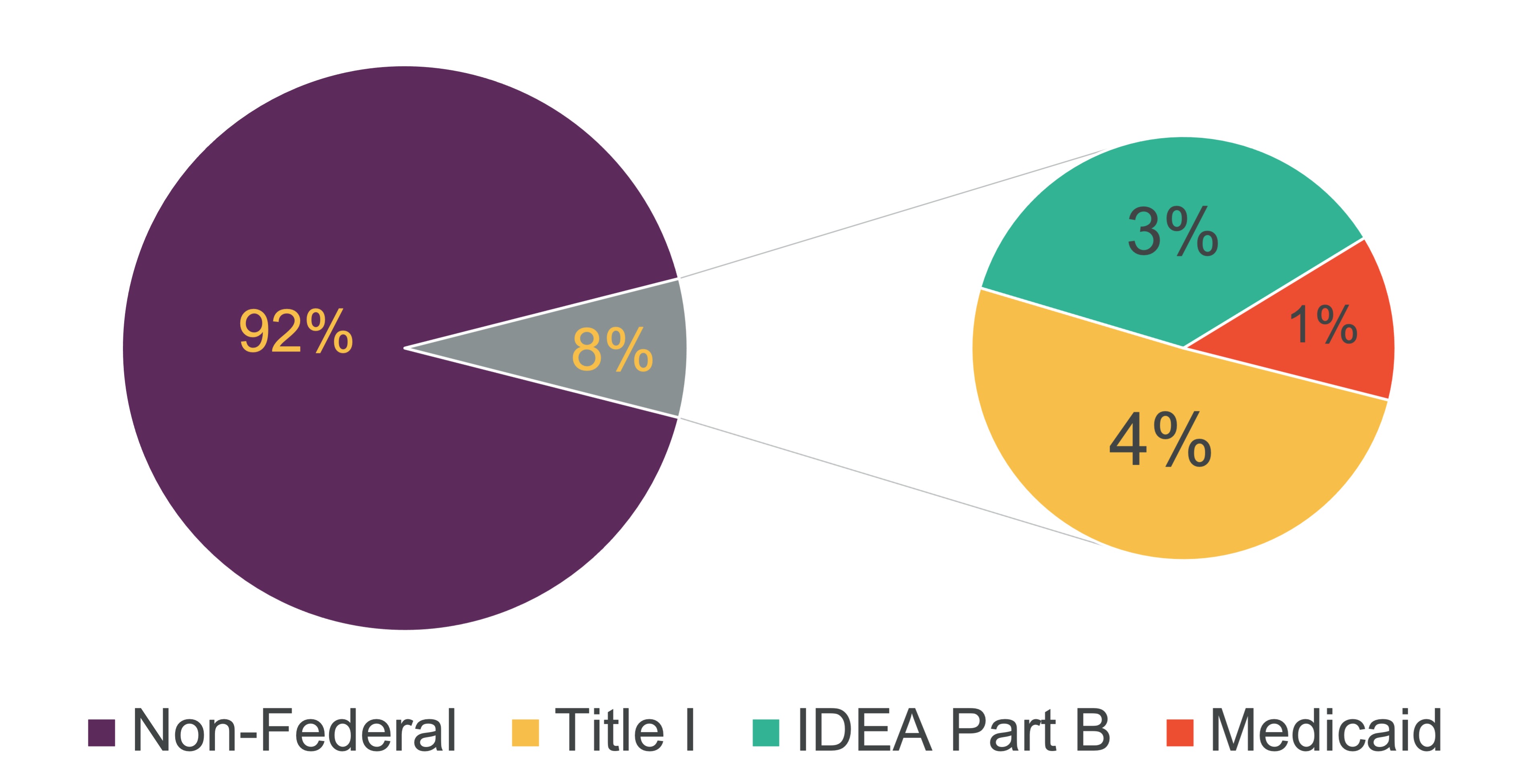
Together, these programs provided about $39 billion to public schools in the current fiscal year. That might sound like a lot—but it’s only about 8% of total school funding across the country. Most money still comes from state and local governments (see Figures 1 and 2).
Figure 1. Funding Source Amounts
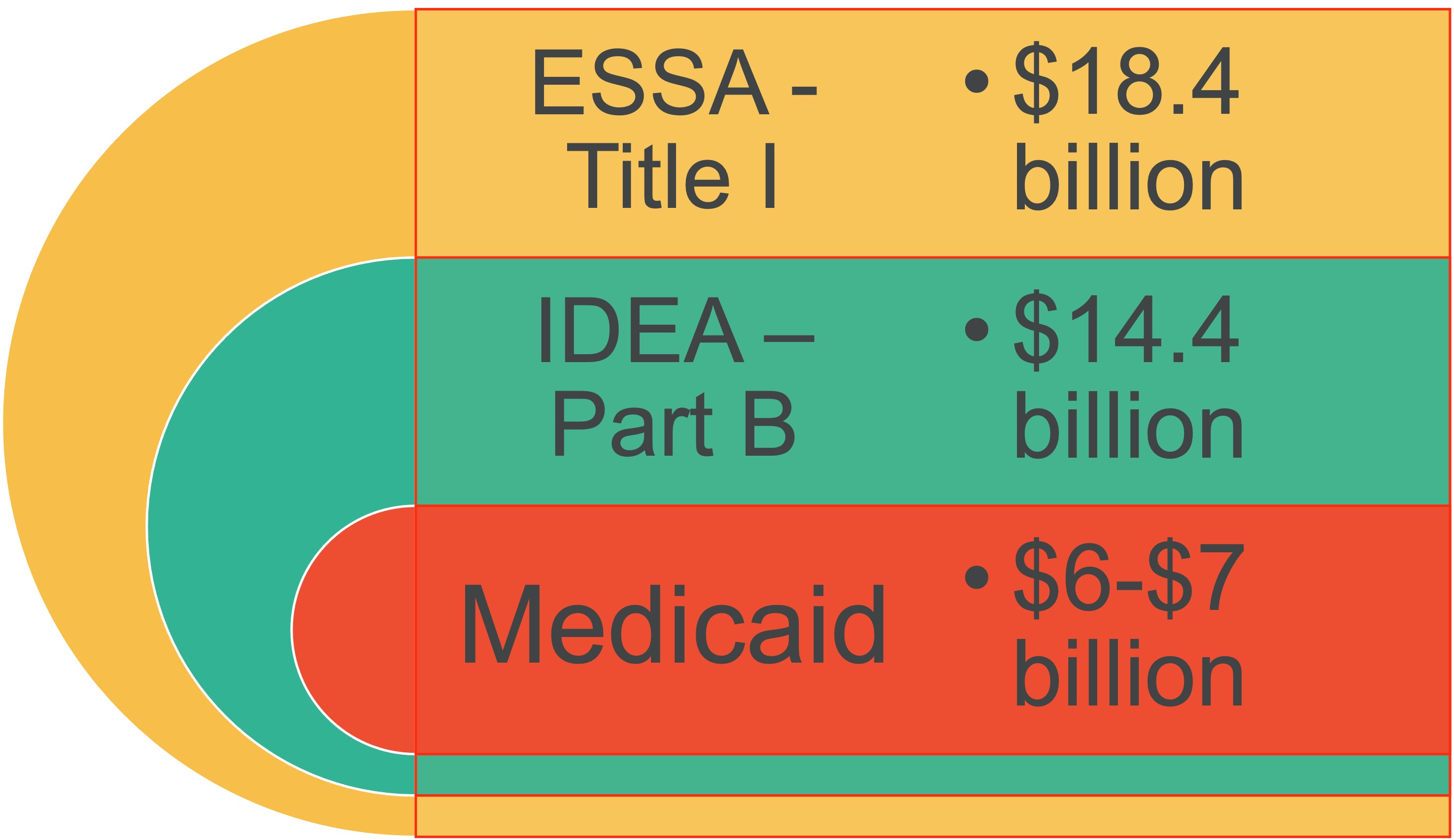
Figure 2. Funding by Source
The ED’s role, however, goes beyond funding. It also offers technical assistance, collects data, and provides guidance that helps states and schools deliver effective and legally compliant services. That includes services provided by OTPs. Federal rules, especially under IDEA and ESSA, protect students' rights to access supports like occupational therapy—ensuring those services aren’t just nice to have, but required under law.
Any significant changes to the ED—such as closing it entirely or transferring IDEA oversight to HHS—would require Congressional approval. Although there have been proposals to do just that, they’ve repeatedly failed to gain enough support. In fact, when Congress last voted on the issue in 2023, more than 60% of the House opposed eliminating the ED. Even the Chair of the House Education and Workforce Committee recently admitted that such a move lacks the 60 Senate votes needed to become law.
A Shift in Focus Creates New Opportunities
As the ED's future remains uncertain, one thing is clear: state and local governments will continue to shape the everyday reality of education. For OTPs, this presents a pivotal moment. About a quarter of all OTPs work in school settings, providing a wide range of services to students and school staff. Their roles are grounded in both IDEA (as related services) and ESSA (as Specialized Instructional Support Personnel, or SISP).
With the federal role shrinking—or at least being called into question—local leaders will likely receive more pressure from families and communities to improve outcomes. This creates a valuable chance for OTPs to step in and demonstrate how their skills support students not only with disabilities, but across all areas of learning and development, including mental health, sensory processing, executive functioning, and social participation. Even without strict oversight by the ED, school leaders will still face pressure to maintain educational standards and outcomes by parents and community leaders. With the threat of federal funding freezes or cuts, administrators will need all the help they can get.
Administrators navigating uncertain funding or shifting rules will need strong allies. OTPs can fill that role, showing how a whole-child approach improves student engagement and performance. As was detailed in a previous article (https://www.aota.org/publications/ot-practice/ot-practice-issues/2024/capital-report-expanding-the-role-of-school-based-ot-practitioners), AOTA has had success leveraging relationships with federal, state, and local education policymakers to increase their understanding of the role of occupational therapy in general education, student mental health, and special education. Now is the time to build on that momentum.
Advocacy is the Key
During the next few years, advocacy by school-based OTPs is going to be more important than ever to ensure occupational therapy remains a visible and valued part of education. At the federal and state levels, OTPs must speak up, urging lawmakers to support their efforts through policy and funding in promoting student success.
As changes to the ED unfold, the risk of losing centralized protections or funding grows. It is crucial for those who support student success to share their story with those responsible for funding education. Visiting AOTA’s Legislative Action Center (http://aota.org/takeaction) is the easiest way to act and urge your elected legislators to provide general and special education with robust funding. By actively engaging with policymakers, OTPs can influence the policies that recognize and expand their role in supporting student participation, mental health, and academic success.
Advocacy doesn’t stop there. It’s just as important, if not more so, to advocate within schools themselves. Education policy often looks very different from district to district and even from one school to the next. Sometimes, administrators unknowingly restrict occupational therapy services simply because they are following old practices or misunderstand the law.
Many OTPs have experienced being told they can’t do something they are trained to do—only to find out the restriction wasn’t based on policy at all, but on habit or misinformation. That’s why school-based advocacy is critical. By educating principals, special education directors, and colleagues about what occupational therapy can offer and what the law allows, OTPs can create space to practice at the top of their license.
Staying Informed and Engaged
To support OTPs during this time of transition, AOTA offers a number of tools and events. The second annual AOTA Back-to-School Celebration will run for the entire month of August, sharing resources to help OTPs advocate and educate others. One key resource, School-Based Occupational Therapy: Myth vs. Reality (https://www.aota.org/advocacy/everyday-advocacy/debunking-eight-sisp-myths), addresses common misconceptions that can limit practice. Visit the AOTA website (http://aota.org/b2s) to explore these materials.
Additionally, AOTA hosts Abraham Thinkin: School-Based Office Hours, a regularly scheduled event where OTPs can ask policy questions, share challenges, and learn more about advocacy. Whether you’re navigating policy, planning advocacy strategies, or celebrating a recent success, this is a great way to stay connected to the broader school-based occupational therapy community. Visit AOTA’s events page for information and registration details.
Final Thoughts
Although the future of the ED remains uncertain, one thing is clear: OTPs have an essential role to play in schools—and an opportunity to make that role better understood, better supported, and more fully integrated into the education system. By advocating at all levels and staying informed, OTPs can help shape the policies and practices that define how students receive the support they need to thrive.
References
Every Student Succeeds Act, Pub. L. 114-95, 20 U.S.C. 6301 (2015). https://www.congress.gov/114/plaws/publ95/PLAW-114publ95.pdf
Individuals With Disabilities Education Improvement Act of 2004, Pub. L. 108-446, 20 U.S.C. §§ 1400–1482.
Abe Saffer, MPM, is one of AOTA’s Federal Lobbyists.