State Occupational Therapy Associations Elevate the Profession
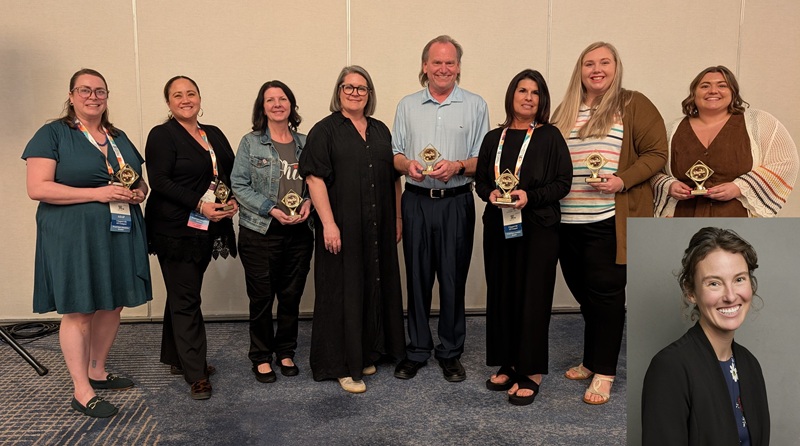 ASAP award winners pose with trophies at the 2026 ASAP Annual Meeting. Pictured left to right: Katie Brooks, Maine Occupational Therapy Association President, Julia Graham, Nevada Occupational Therapy Association President, Christie Tuttle, Ohio Occupational Therapy Association President, Courtney Everett, Mississippi Occupational Therapy Association President-Elect, Peter Giroux, Mississippi Occupational Therapy Association President, Cathleen Johnson, Michigan Occupational Therapy Association President, Sydney Marshman, Iowa Occupational Therapy Association President, and Laura Aust, Indiana Occupational Therapy Association President. Inset photo is of Molly Hahn-Floyd, Occupational Therapy Association of Colorado President.
The Affiliated State Association Presidents (ASAP) held their annual meeting on April 20–21, 2026, at AOTA Inspire 2026 in Anaheim, California. Discussions included meetings with AOTA leadership, updates from AOTPAC and the Representative Assembly, OT Compact developments, strategies for promoting state associations and enhancing membership value, and updates on motions. Outgoing state presidents and ASAP Steering Committee members received AOTA Service Commendations.
ASAP also recognized outstanding state associations with awards in four categories. This year, 15 states submitted 20 entries, showcasing their dedication and hard work in advancing the occupational therapy profession.
Advocacy Award
Iowa Occupational Therapy Association (IOTA)
IOTA led the launch of Iowans for Section 504 in partnership with a contract lobbyist, leveraging established legislative relationships to rapidly mobilize a coordinated advocacy response to Iowa's involvement in the Texas vs. Becerra lawsuit. The coalition brought together more than a dozen interdisciplinary organizations representing healthcare, disability advocacy, and professional associations, all unified around urging the Iowa Attorney General to remove the state from litigation challenging the constitutionality of Section 504.
This initiative reflects a strategic evolution beyond traditional grassroots advocacy. By combining direct lobbying expertise with cross-sector coalition building, IOTA expanded its influence and elevated both professional and lived-experience perspectives. The effort gained visibility through print and media coverage, demonstrating how state associations can move beyond isolated advocacy to create unified, high-impact responses to urgent policy issues. This model is highly replicable for associations seeking to build influence across disciplines.
Michigan Occupational Therapy Association (MiOTA)
MiOTA's Advocacy Committee developed 'MiOTA on the Road: Advocating from the Capitol to Your Community,' a multi-pronged initiative to broaden awareness, participation, and understanding of advocacy statewide. Key components included:
- Mini Lobby Day Events hosted outside the Capitol on university campuses, offering round-table discussions with legislators and small-group breakout sessions. These events rotated across different regions of the state at no cost to the association, increasing student and faculty participation and interest in the advocacy committee.
- Year-round organizational support through the MiOTA Advocacy Director and committee, providing resources via email communications, webinar recordings, and website postings. Members and non-members could reach out to the committee for scope-of-practice clarification, increasing confidence in professional boundary advocacy.
Professional Development Award
Ohio Occupational Therapy Association (OOTA)
In 2026, OOTA built the infrastructure to sustain member learning for years to come. Three new standing committees were launched, each targeting a distinct dimension of professional growth:
- Mentorship Committee — connects emerging practitioners with experienced leaders, investing in the profession's future from within.
- Microcredentialing Committee — positions members to pursue stackable, competency-based credentials in response to evolving national continuing education trends.
- Newsletter Committee — keeps members consistently informed, engaged, and connected to the association's work and the broader profession.
OOTA also introduced two new programming events. Winterfest, delivered virtually with over 14 hours of content, removed geographic and financial barriers to CE participation. The Feeding Symposium brought focused, specialty-level content to practitioners in a high-need clinical area. Together, these five initiatives reflect a deliberate, multidimensional professional development strategy — not a reaction to a single gap, but a vision for a thriving state association.
Mississippi Occupational Therapy Association (MSOTA)
MSOTA's 50th Anniversary Celebration and Annual Conference, held March 20–21, 2026, honored OT roots with three classic tracks: pediatrics, physical dysfunction, and psychosocial. Advertising began six months in advance, and a Friday night 'Capstones and Cocktails' event showcased local OTD student capstone and research projects, drawing 185 attendees.
A MSOTA Historical Booth displayed scrapbooks, photographs, and artifacts depicting early OT in the state, with past presidents sharing stories at a panel discussion. The full-day Saturday conference sold out at 479 participants — exceeding the venue's capacity of 475 — making it a record high for the state conference. Early closures of the pediatric and psychosocial tracks meant even greater demand went unmet. The event attracted 18 sponsors including AOTA, AOTPAC, and NBCOT, and helped grow association membership to 684 members.
Membership Growth Award
Indiana Occupational Therapy Association (IOTA)
In 2025, IOTA launched a membership growth initiative to address stagnant growth through two strategies: a corporate membership program and a 50% off membership campaign.
The corporate membership program engaged organizations, schools, and companies rather than relying solely on individual recruitment. Partners received quarterly social media spotlights and complimentary vendor opportunities at the annual conference. The board also purchased Indiana's state licensure database and reached out to all licensed non-members, offering a one-year introductory membership at 50% off, followed by personalized follow-up from board members.
Results were substantial: the corporate program secured three organizational partners generating 20 new members, while the discount campaign brought in 50 new practitioners — an 11% overall membership increase, including a 25% increase in OTA membership that broadened professional representation. Both strategies are replicable and offer a roadmap for associations seeking measurable growth.
Occupational Therapy Association of Colorado (OTAC)
OTAC implemented two strategic changes to expand and diversify its membership base. A new group membership option allows organizations to enroll multiple employees at a 15% discount, making it especially attractive to healthcare systems, clinics, and educational programs seeking cost-effective professional benefits.
OTAC also restructured its corporate membership program from a single tier to three levels, including a new entry-level option designed to be more attainable for smaller organizations and emerging companies. This tiered structure allows businesses to engage at a level aligned with their capacity while still receiving visibility, networking opportunities, and access to the professional community. Together, these initiatives prioritized flexibility, affordability, and inclusivity — creating sustainable pathways for individuals and organizations to support OTAC's mission.
Innovative Ideas Award
Nevada Occupational Therapy Association (NOTA)
In 2026, NVOTA partnered with Nevada's physical therapy and speech-language pathology associations to co-produce a joint interprofessional continuing education conference in Las Vegas on June 6–7. Rather than competing for the same practitioners' time and resources, the three associations built something larger than any one profession could create alone.
A key feature of this initiative was a financial collaboration rubric developed by NVOTA to guide equitable cost-sharing and revenue distribution among the three associations — transforming what could have been a complex negotiation into a transparent, replicable framework. Programming was intentionally interprofessional in design, not simply co-located single-discipline sessions, with a dedicated planning committee meeting weekly to coordinate the call for papers, sponsorship, budgeting, and program development.
Equally important was the coalition's deliberate outreach to rural, frontier, northern, and tribal communities across Nevada. By prioritizing voices from geographically diverse regions, the conference ensured that therapy communities across the state felt seen and represented. This model is directly transferable to any state association seeking to stretch limited budgets, strengthen cross-professional relationships, and deliver richer continuing education experiences.
Maine Occupational Therapy Association (MEOTA)
MEOTA shifted to a student-led governance model with measurable results. Student Representatives from all Maine OT institutions were granted collective voice and vote on the Executive Board. A student representative-driven Needs Assessment Survey (n=60) identified cost and value as primary barriers to membership, leading to the launch of the Student BOGO Membership.
The results were striking: a 51% increase in student memberships in 2025 and a 700% increase in first-year practitioner membership, demonstrating strong conversion from student to professional engagement. Additional data-driven changes included reducing conference fees to $20, hosting NBCOT-partnered student luncheons, and establishing a Student Liaison board position to mentor emerging student leaders.
The MEOTA Student Newsletter, published semi-annually since 2024, sustains engagement across institutions, highlights student-led initiatives, and makes leadership opportunities visible and accessible. Students have shifted from passive recipients of information to active contributors to a broader professional community. This stepwise, low-cost model is highly replicable for state associations seeking to strengthen student engagement and build a sustainable leadership pipeline.
Congratulations to all 2026 ASAP Award Winners!